
ERP for Construction Companies in UAE: Complete Guide
Let’s have a detailed discussion on how a well-implemented construction ERP UAE platform enables construction companies to manage projects, resources, finances, and workforce operations through a single integrated system. So, you can understand the way it helps contractors maintain better operational control, improve project coordination, and monitor project profitability across multiple construction sites.
We’ll also help you choose the best ERP for construction companies UAE. So, let’s get started.
What is ERP for Construction Companies?
Enterprise Resource Planning (ERP) for construction companies refers to a centralized software system that coordinates construction operations, financial management, workforce administration, and project execution through a unified digital platform.
Basically, a construction ERP system connects departments such as project management, procurement, inventory control, accounting, and payroll so that every project activity flows through one structured system instead of multiple disconnected tools.
In practical terms, ERP for construction companies acts as the operational backbone of the business. Project managers oversee project budgets and progress. Procurement teams handle material purchases and supplier coordination. Inventory teams monitor material availability across project sites. Finance departments manage project costs, invoicing, and financial reporting.Workforce teams administer worker attendance, payroll calculations, and subcontractor payments.
All operational activities connect through the ERP system so that project information remains consistent and accessible across the organization.
For instance, you’re running a construction company that manages multiple building projects simultaneously. You must agree that each project requires material procurement, subcontractor coordination, workforce scheduling, and budget monitoring.
Right?
So, you can leverage an ERP for contractors UAE to:
- record project budgets
- generate procurement requests for required materials
- track inventory delivery to project sites
- calculates workforce payroll
- updates financial reports automatically as project expenses occur.
So, all managers therefore receive a clear operational view of project progress, resource usage, and financial performance.
Notably, project management ERP UAE also maintains a centralized database for project records, contracts, purchase orders, invoices, and financial transactions. Teams across departments access the same information source, which improves coordination between project teams, finance teams, and operational staff. Ultimately, ERP for construction companies UAE enables decision makers to effectively review accurate project data before allocating resources, approving expenses, or adjusting project timelines.
Key Features of ERP for Construction Companies UAE
- Project costing and budget control allow construction companies to define project budgets, allocate expected costs for materials and labor, and monitor expenses throughout the project lifecycle.
- Subcontractor management helps project teams coordinate subcontractor contracts, assign work orders, and track payment schedules within a structured operational system.
- Inventory and material tracking ensure that construction materials are recorded from procurement through warehouse storage and delivery to project sites.
- Procurement and purchase order management support structured supplier coordination by generating purchase requests, managing supplier quotations, and issuing purchase orders aligned with project requirements.
- Workforce and payroll management enable companies to track worker attendance, allocate labor across projects, and calculate payroll based on recorded work hours.
- Financial management and project accounting integrate project expenses, supplier payments, client invoices, and financial records within a centralized accounting environment.
- Document and contract management maintain organized storage for project contracts, purchase orders, drawings, and compliance documents within a centralized digital repository.
- Project performance reporting and dashboards provide managers with operational visibility through real-time reports that display project progress, cost performance, and resource utilization.
How ERP Systems Manage Construction Projects?
Suppose you run a construction company that manages several building projects across different locations in the UAE. Each project requires material procurement, workforce allocation, subcontractor coordination, and continuous budget monitoring. Project managers, procurement teams, finance departments, and site supervisors all contribute to project execution. If these activities operate through separate spreadsheets or disconnected tools, project coordination becomes difficult and operational visibility remains limited.
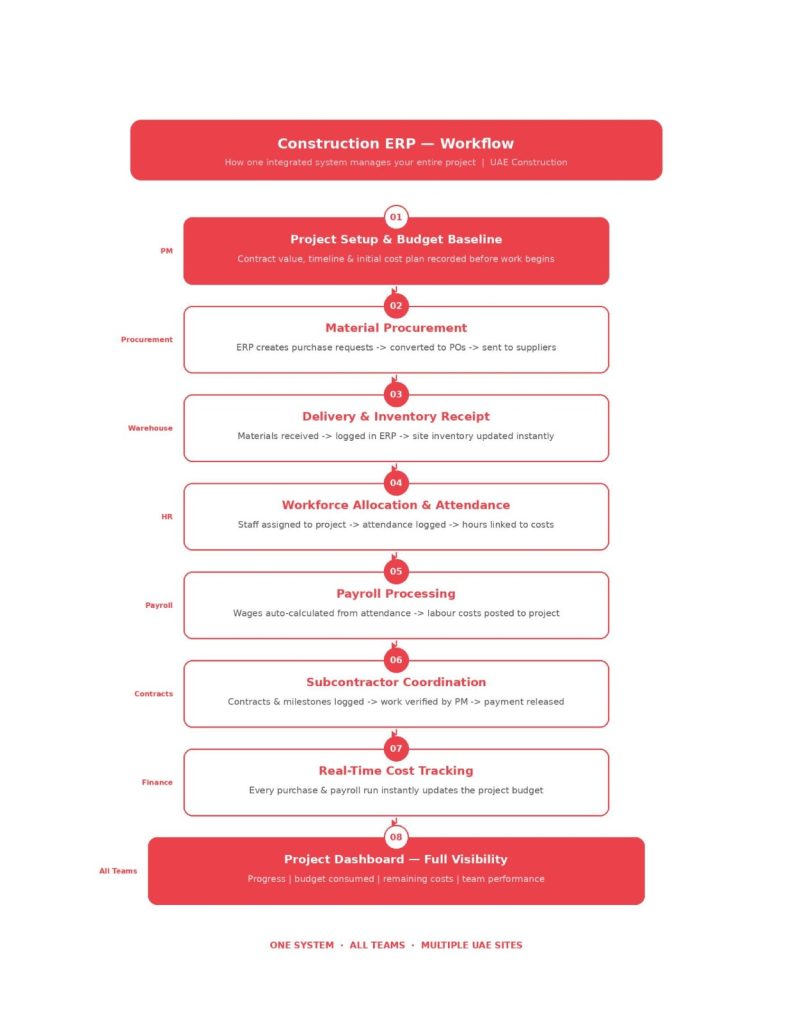
Now consider how an ERP for construction industry UAE manages this process.
First, you create a new project inside the ERP system. The system records the project details, contract value, expected completion timeline, and initial project budget. Project managers then allocate estimated costs for materials, labor, equipment, and subcontractor services. So the ERP platform establishes a structured financial plan before project execution begins.
Next, procurement teams review project requirements. If the project requires cement, steel, electrical components, or other materials, the ERP system generates purchase requests based on the project plan. Procurement staff convert these requests into purchase orders for approved suppliers. When suppliers deliver materials, warehouse teams record the inventory receipt inside the ERP system. Then the system updates material availability for the project site.
Now consider workforce coordination. Construction companies assign engineers, supervisors, and workers to specific projects. If site workers record attendance through the ERP platform, the system links their work hours directly to the project. Payroll teams later calculate wages based on recorded attendance and project allocation.
Subcontractor coordination follows a similar process. Suppose a subcontractor handles plumbing installation or structural work for the project. The construction ERP UAE system records subcontractor contracts, task assignments, and payment milestones. Once project managers verify completed work, finance teams process subcontractor payments through the ERP platform.
Throughout the project lifecycle, the ERP system records all operational transactions. If procurement teams purchase additional materials, the system updates project expenses immediately. If payroll teams process worker salaries, the system records labor costs within the project budget. Then project managers review dashboards that display project progress, cost consumption, and remaining budget capacity.
So the ERP system maintains a continuous operational record of the entire construction project. Managers therefore review project performance with accurate data instead of relying on fragmented reports.
Ultimately, it is clear that construction companies rely on ERP solutions to coordinate teams, control project costs, and maintain operational visibility across multiple construction sites through one integrated system.
Benefits of ERP Solutions for Construction Companies in UAE
- Construction companies gain stronger control over project costs. ERP systems record every expense related to materials, labor, equipment, and subcontractor services so project managers can review budget utilization throughout the project lifecycle.
- Teams across departments coordinate work more efficiently. Project management ERP UAE connects project managers, procurement teams, finance departments, and workforce administrators through a unified operational system.
- Managers receive real-time visibility into project performance. ERP dashboards display project progress, resource usage, and financial updates so decision makers can respond quickly to operational changes.
- Material planning and inventory supervision become more reliable. ERP systems track procurement orders, warehouse stock levels, and material delivery to construction sites.
- Subcontractor coordination becomes easier to manage. ERP platforms record subcontractor agreements, monitor task completion, and support structured payment processing.
- Workforce administration becomes more organized. Construction ERP UAE systems maintain worker attendance records, allocate labor across projects, and support payroll calculations.
- Operational information remains centralized across the company. ERP platforms store project documents, financial transactions, procurement records, and workforce data within one integrated database.
- Construction companies gain clearer financial insights. ERP systems generate project-based financial reports that help management evaluate profitability and operational performance.
How to Choose the Best ERP for Construction Companies?
Now, let us walk you through 5 quick steps you can follow to choose the best ERP for construction companies UAE.
Step 1: Identify Construction Business Requirements
The first step in selecting the right ERP system involves understanding how your construction business currently operates and which operational challenges require improvement. Construction companies coordinate multiple project activities such as budgeting, material procurement, workforce allocation, subcontractor management, and financial reporting. A clear evaluation of these operational workflows helps decision makers determine which ERP capabilities are necessary to support project execution and company-wide operations.
During this assessment, construction companies should review key operational areas such as:
- Project management requirements, including project planning, scheduling, and progress tracking across multiple construction sites.
- Project costing and financial tracking, covering budget allocation, expense monitoring, and project profitability analysis.
- Material procurement and inventory management, including supplier coordination, purchase orders, warehouse inventory, and site-level material usage.
- Subcontractor coordination, covering subcontractor agreements, work assignments, and milestone-based payment processing.
- Workforce and payroll administration, including worker attendance tracking, labor allocation across projects, and payroll calculations.
Step 2: Understand the Types of ERP Systems Available
Construction companies should review the available ERP deployment models and select the option that aligns with their operational environment, IT infrastructure, and project coordination needs.
- Cloud ERP. Choose cloud ERP if your company manages multiple project sites, remote teams, or distributed offices. Cloud systems allow project managers, procurement teams, and finance departments to access the ERP platform from any location through secure internet access.
- On-Premise ERP. Choose on-premise ERP if your company requires full control over data storage and system infrastructure. Large construction firms with internal IT teams often prefer this model because servers and system management remain within the company’s environment.
- Construction-Specific ERP. Select ERP platforms designed specifically for construction companies. Notably, this type of ERP systems include built-in capabilities for project costing, subcontractor coordination, procurement workflows, and site inventory tracking.
- Modular ERP Systems. Choose modular ERP if your company prefers gradual system adoption. Companies can begin with essential modules such as finance or procurement and expand to project management, workforce management, and inventory control as operational complexity increases.
Step 3: Evaluate Construction-Specific ERP Features
After understanding the ERP types available, construction companies should examine whether the system includes features that support construction operations. The ERP platform must align with project-driven workflows and provide operational visibility across projects.
Evaluate whether the ERP system supports the following capabilities:
- Project management and scheduling, so project managers can plan project phases, assign tasks, and monitor execution progress.
- Project costing and budget tracking, which allow companies to allocate project budgets and monitor material, labor, and subcontractor expenses.
- Subcontractor management, enabling teams to manage subcontractor contracts, work orders, and milestone-based payments.
- Material procurement and inventory tracking, so procurement teams can generate purchase orders and monitor stock movement across warehouses and project sites.
- Workforce and payroll management, allowing companies to record worker attendance, allocate labor across projects, and process payroll accurately.
Step 4: Assess System Integration, Scalability, and Reporting Capabilities
Construction companies should evaluate whether the ERP system can connect with existing business tools, support company growth, and provide clear operational reporting. The ERP platform must integrate different business functions and provide reliable insights for project management and financial decision making.
During evaluation, companies should review the following aspects:
- System integration capability, so the ERP can connect with tools such as CRM systems, accounting platforms, payroll software, or project management applications already used by the company.
- Scalability for growing operations, allowing the ERP system to support additional projects, users, warehouses, and business units as the company expands.
- Real-time reporting and dashboards, so managers can review project progress, budget utilization, resource allocation, and financial performance from a centralized dashboard.
- Data accessibility across departments, ensuring project managers, procurement teams, finance staff, and executives can access accurate operational data when making decisions.
Step 5: Compare ERP Vendors and Implementation Support
After evaluating ERP features and system capabilities, construction companies should compare ERP vendors and review the implementation support they provide. The success of an ERP system depends not only on software functionality but also on proper implementation, customization, and ongoing technical support.
During vendor evaluation, companies should review the following factors:
- Construction industry expertise, so the vendor understands construction workflows such as project costing, subcontractor coordination, and procurement planning.
- Implementation and system setup support, ensuring the vendor provides assistance with system configuration, data migration, and project deployment.
- Customization capability, allowing the ERP platform to align with the company’s project management processes and reporting requirements.
- Training and ongoing technical support, so project teams and operational staff can use the system effectively and receive assistance when required.
Partner with DooERP for Fully-Customized Construction ERP Solutions
DooERP, a subdivision of Doodle Technologies, supports construction companies through ERP systems designed specifically for project-driven environments.
Construction companies in UAE partner with DooERP to support:
- Project costing and budget monitoring across construction projects
- Subcontractor coordination and milestone-based payment tracking
- Material procurement and inventory supervision across project sites
- Workforce attendance management and payroll calculations
- Real-time dashboards that display project performance and financial outcomes
DooERP implementation teams review your company’s operational workflows, configure ERP modules according to project requirements, and deploy a system tailored to construction operations. Rest assured that our structured approach helps construction companies maintain stronger project control, improve operational coordination, and monitor project profitability across multiple construction sites.
Connect with DooERP today for a live demo of ERP for construction companies UAE. It will show how a customized construction ERP system can support efficient project management and long-term operational growth.

Addresses
-
Al Sayid St Office 302, Saeed Abdulla Nasser
Al Junaibi Bldg - Al Zahiyah - Abu Dhabi
United Arab Emirates -
Rashid Al Makhawi Building - 18 - Mezzanine
Floor 109 Umm Hurair Rd - Oud Metha -
Dubai United Arab Emirates
- Abu Dhabi: +971 2 6711 640
- Dubai: +971 4 2619 680